
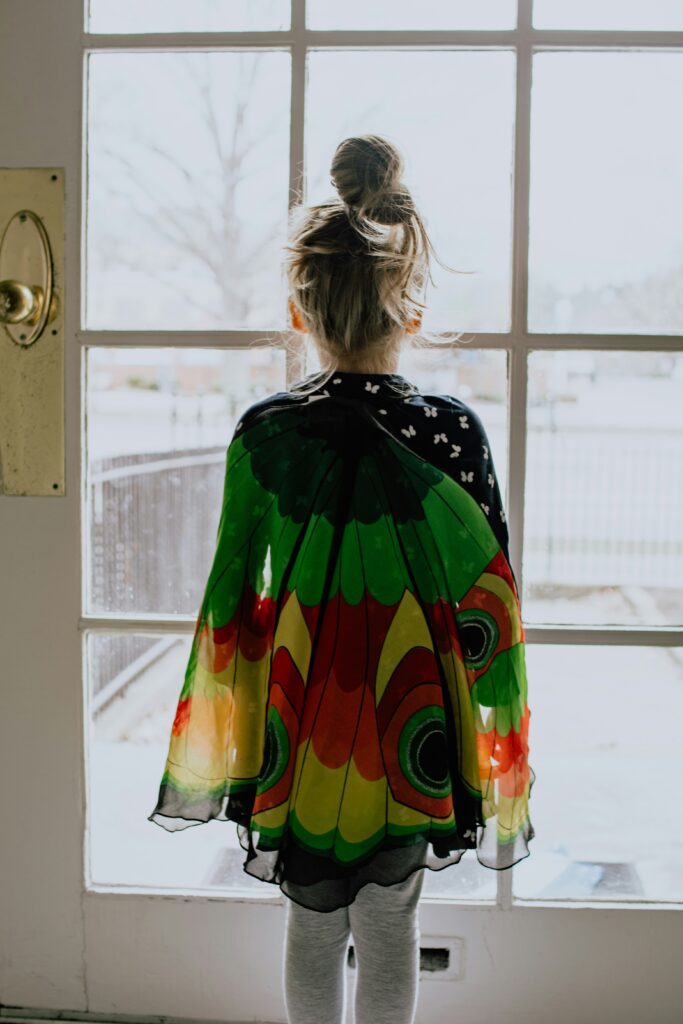
Creativity often begins long before it is named.
For many people, it arrives as instinct rather than intention – an orientation toward making, imagining, moving, shaping. As children, expression unfolds without audience or outcome: drawing for hours, inventing stories, moving to music, assembling meaning through play.
Creativity exists without explanation.
It isn’t productive.
It isn’t strategic.
It simply is.
In those early moments, creativity functions less like a skill and more like a place , somewhere internal, familiar, steady.
Home.
Before creativity is evaluated or measured, it often serves a quieter role. It helps organise inner experience. It allows emotion, curiosity, and imagination to move without needing translation. Time disappears. Attention settles. Expression happens without asking whether it is “good.”
Psychologically, this aligns with intrinsic motivation – engaging in something because it is inherently satisfying. When creativity arises from this place, the nervous system softens. Focus deepens. Expression feels alive rather than extracted.
This kind of creativity does not seek legitimacy.
It does not require permission.
It does not ask where it is going.
It simply moves.
Creativity doesn’t disappear.
It goes quiet when the conditions aren’t safe.
Freedom alone is not enough.
For creativity to emerge fully , in childhood or adulthood , the nervous system must feel settled. Expression needs conditions where it is not overly monitored, rushed into performance, or burdened with expectation. Where it is not required to regulate other people’s emotions or carry meaning too soon.
Some environments offer freedom without being holding.
Others encourage expression primarily as display.
Both can quietly shape how and whether creativity continues.
This is not about fragility or talent.
It is about conditions.
When the nervous system feels safe, expression expands. When it feels observed, responsible, or under pressure, expression often contracts as a form of protection.
Many people do not lose their creativity.
They learn to quiet it.
As life progresses, survival often takes precedence over expression.
Structure, productivity, and responsibility become necessary skills, particularly in systems that reward output over inner process. These environments can teach discipline and reliability , but they rarely provide the conditions creativity needs to feel at home.
The contrast starts to become clearer later on.
Creative spaces, especially those shared with other creatives, tend to feel different. Energy circulates. Ideas expand rather than compete. Expression is met with recognition instead of evaluation.
There is a sense of shared language, even across disciplines.
This isn’t preference alone.
It is relational nourishment.
Creativity, in this sense, is not just something people do.
It is a place they return to.
And certain people feel like home because they meet them there.
Creativity is not just an act.
It is a place of return.
Something subtle shifts when creativity is asked to justify itself.
When expression becomes oriented toward proof such as metrics, comparison, visibility, it often moves from presence into performance. The work tightens. Attention turns outward. The original impulse becomes harder to hear.
Structure itself isn’t the issue. Many creatives work well within gentle frameworks.
What alters expression is pressure, especially pressure that feels evaluative or controlling.
Research on motivation supports this distinction.
External rewards such as money or recognition don’t automatically diminish creativity. What matters is how they are introduced. Pressure changes the nervous system the work is created inside.
It isn’t that money ruins art.
It’s that pressure reshapes the conditions under which art is made.
Throughout history, creativity has a tendency to resurface when familiar structures collapse.
Periods of uncertainty, wars, economic depressions, social upheaval, cultural reckonings, are often followed by waves of artistic and creative expression.
Not because creativity is ornamental, but because it is regulatory.
It helps people metabolise disruption, grief, and change.
The COVID-19 pandemic was not an exception – only a recent and visible example.
During lockdowns, many people returned to making. Studies across multiple countries showed increases in creative activity alongside improvements in emotional wellbeing.
Creativity functioned less as output and more as regulation – a way to reconnect when external certainty disappeared.
COVID didn’t make everyone an artist.
It gave many people permission to return to expression.
Creativity does not exist on a hierarchy. It exists in relationship.
Some people create to feel good. Some create to heal. Some create to play.
Some create because it shapes identity. Some create because they build their lives around it.
None is better than another.
Each asks for a different level of devotion, sensitivity, and care.
Creativity may be universal, but being an artist often functions as a vocation – paid or unpaid. It involves sustained engagement, the development of craft, and a willingness to express deeply, often without certainty of how the work will be received.
Artists do not control how their work lands. Its impact may be subtle or profound, immediate or delayed.
In this sense, art becomes sustenance, available when others cannot yet articulate what they feel.
Money can support creative life.
It does not need to justify it.
At some point, creativity may enter exchange.
Some art is shared freely.
Some art is offered as service.
And when art becomes service, money enters the relationship.
At its healthiest, money functions as support, not validation.
It provides time, space, and the capacity to rest and return. It can create the conditions necessary for sustained expression without depletion.
Tension only arises when money becomes permission rather than support.
In contemporary culture, creativity is often rushed toward monetisation as proof of value. Yet not all creativity wants to be monetised. Some forms of making want to remain private, playful, or nourishing, feeding creative abundance rather than funding it.
What matters is discernment.
How creativity is held.
What it is asked to do.
And whether it is allowed to remain connected to its original impulse.
What becomes most interesting over time is not defending creativity or justifying its exchange.
It is noticing how quickly creativity is asked to prove itself, nd what happens when it isn’t.
Money can support creative life.
But it doesn’t need to be the reason creativity is allowed to exist.
Some forms of expression want to remain places of return –
not sites of performance,
not measures of worth,
but spaces where something essential can breathe.
And perhaps that is what it means
when creativity is home.
~H


Comments +